Ontario competitive gymnastics uses several names and tracks — CanGym, Xcel, CCP, Aspire, Youth Entry, HP. They are parallel pathways, not one ladder. This guide explains how they fit together.
Gymnastics in Ontario can be confusing once you hear terms like CanGym, Xcel, CCP, OCP Aspire, Youth Entry, and HP.
These are not all “levels” in the same system. They are different pathways, and understanding how they relate makes progression much easier to follow.
The most important idea
Gymnastics is not one ladder. It is a set of parallel pathways. A gymnast typically enters one stream and progresses within it. Moving between streams does happen, but it is usually an intentional decision and often a difficult transition — not the normal or automatic next step.
A simplified view:
Xcel and CCP are different competitive tracks. One is not simply the next step after the other.
Most kids begin in recreational gymnastics. In Canada, that is often structured through CanGym — skill development, coordination, and safe progression.
CanGym is not the same as competitive levels. “CanGym Stage 8” does not map directly to “Level 4” or any competitive label. It is recreational stream, not the competitive ladder.
A competitive stream that is often more flexible, with less time commitment. It can be a strong long-term fit for many gymnasts, however is not designed as a developmental pathway towards higher-level competition.
Progression stays within Xcel. Think of it as its own pathway, not a feeder into CCP.
Canadian Competitive Program — the numbered stream (Level 3, 4, 5…). Many families know it by the old USA program name, JO, now called Development Program. In Canada its officially CCP.
For many families this feels like the “traditional” progression — but it is still one pathway among several.
Within CCP, numbered levels are grouped into two phases. Compulsory levels (Levels 1–5) and optional levels (Levels 6–10) work differently, and the names describe what happens in competition.
Compulsory (1–5): Athletes perform the same prescribed routines on each apparatus. Everyone is judged on the same choreography and skill set, so it is easier to compare one gymnast to another, and there is essentially no “picking your own routine” at this stage.
Optional (6–10): There is more flexibility in how routines are choreographed and which skills are shown. Rules still require that certain types of skills appear in each routine (for example, particular families of elements on bars, beam, etc.). So optional is not “anything goes” — coaches build routines that meet those requirements while playing to each athlete’s strengths.
A common myth: JO/CCP is the Olympic pathway by default. It is not. CCP is competitive development, separate from elite / HP. Progressing through CCP levels does not mean a gymnast is on an Olympic track.
Elite in Canada is usually discussed as HP (High Performance) — different demands, different pool of athletes, not simply “the next level” after CCP.
Aspire and Youth Entry are early pre-elite / talent-ID style pathways, closer to high performance than ordinary CCP level moves.
They are not “the next numbered step” after a strong CCP season. They are selective, depend on club structure and athlete profile, and need a deliberate conversation — not an assumption.
Most gymnasts pick a stream and grow inside it:
Cross-stream moves can happen but are often harder than parents expect — usually a deliberate choice, not a natural graduation.
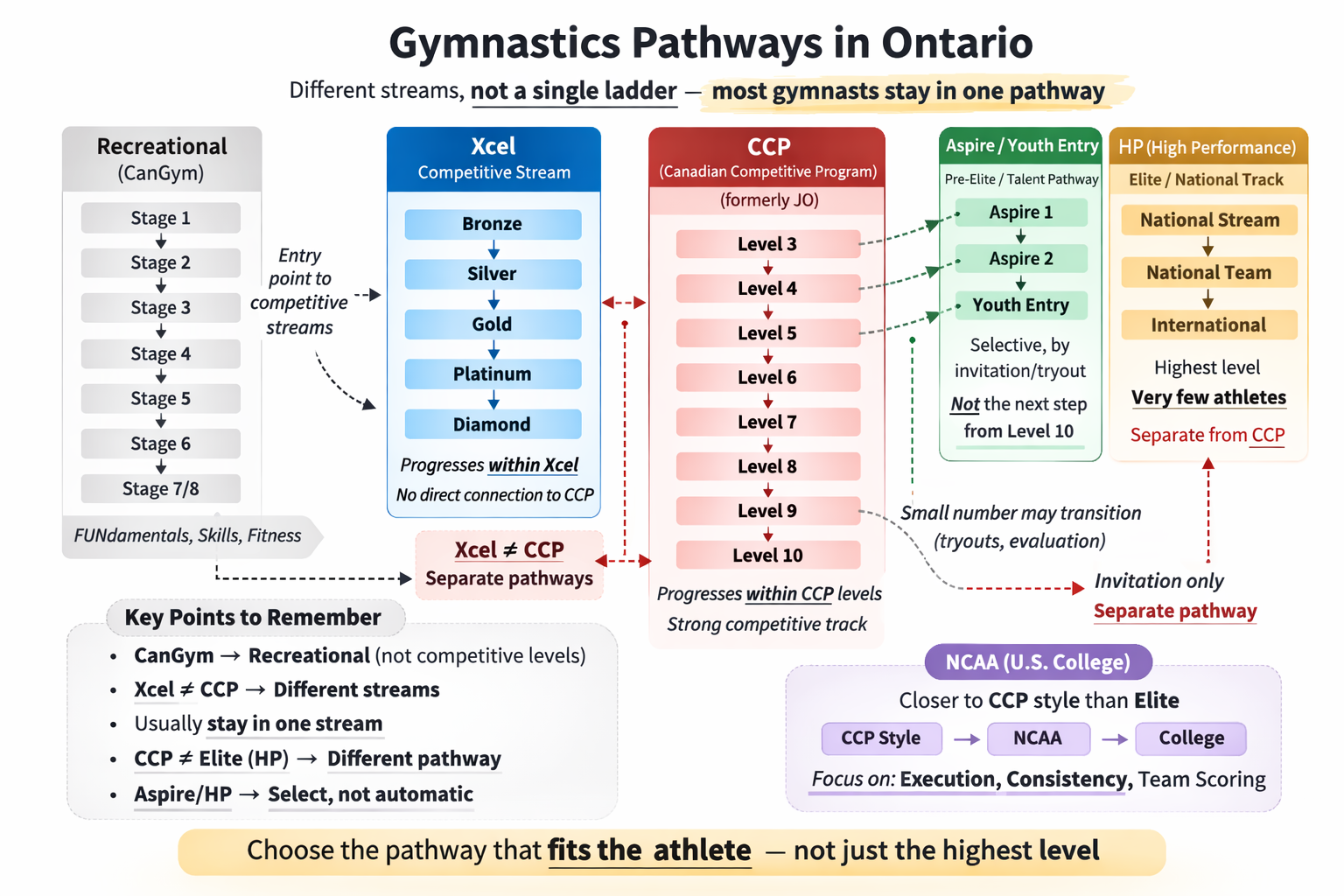
NCAA gymnastics is generally closer to strong CCP-style gymnastics than to elite. Elite stresses maximum difficulty and international performance; NCAA stresses execution, consistency, and team scoring.
A gymnast can thrive in CCP and even NCAA without ever being on an elite pathway. That is completely normal.
Many top-tier NCAA gymnasts came up entirely in the JO/CCP style programs.
Elite gymnastics is a different scoring structure (FIG) than CCP or NCAA gymnastics. The pathway to the Olympics goes through elite, or in Canada, the High Performance program.
It is a pathway change, not a promotion.
Not always. A high score can mean she is thriving where she is — not that a harder stream is right.
No — CCP and elite are separate tracks.
No — specialized pathways, not ordinary next steps.
Not necessarily. Cross-stream transitions are demanding; results alone don’t tell the whole story.
Instead of only asking “What’s the next level?”, try:
“Is my child well-matched to this pathway?”
Then ask whether the next step within that pathway is realistic, or whether a more specialized option is worth understanding with your coach.
GymRankings focuses on scores, rankings, and competitive context for Ontario families — including meet results, province-wide rankings, athlete comparisons, pathway-style signals, and other insights.
The goal is to make competitive gymnastics easier to understand. Some features reflect current results; others compare an athlete to similar gymnasts from past seasons. GymRankings can help you ask better questions — it does not replace your coach on readiness, training, or long-term goals.